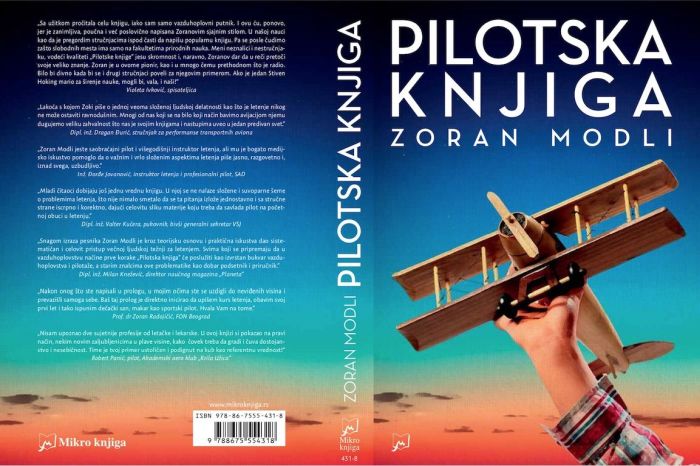
AUTOR IZ DAVNOG VREMENA KADA JE PISAO SVOJU PRVU KNJIGU „KRILATA KATEDRA”...
Poput mnogih drugih, tako je i Zoran Modli rođen sredinom prošlog veka u Zemunu i za sada je živ i zdrav. Nije odmah postao pilot. Najpre je kao odlikaš završio osnovnu školu, a onda alarmantno srozao uspeh u Prvoj zemunskoj gimnaziji. Od mature se oporavio u redakciji „Politike ekspres”, a sa dvadesetak godina proslavio kao revolucionarni disk-džokej Studija B i legendarne zemunske diskoteke „Sinagoga”. Studio B je, posle pet godina, napustio iz više razloga, a najviše zbog letenja. Od tada je jednom nogom u raznim radijima, a drugom i obema rukama u avijaciji. Pošto je bliska rodbina, a naročito najbliža – majka – očekivala da završi kakav-takav fakultet, uradio je pola posla, pa završio Višu vazduhoplovnu pilotsku školu u Beogradu.
Kao instruktor letenja, najpre na sportskim aerodromima, a zatim u Pilotskoj akademiji JAT u Vršcu, školovao je na desetine naših i stranih pilota. Mnogi od njih odavno su kapetani JAT-a, ali i drugih kompanija širom sveta. Dvadeset godina je leteo u JAT-u, a najviše vremena proveo na nikad prežaljenom boingu 727, nad kojim lamentira kad god mu se za to pruži prilika. Od ranih devedesetih pa sve do prvog poglavlja ove knjige leteo je i kao kapetan na biznis-džetovima kompanije Prince Aviation. Za njim su bezbrojni sati sjajnih iskustava. Poslednje je bilo loše, ali korisno za ovu knjigu.
Živi u Beogradu, a u mislima u svim onim gradovima na čije je aerodrome sletao.

... I U OVA NOVA VREMENA, DOK OČEKUJE NOVO IZDANJE „PILOTSKE KNJIGE“.
When foreigners search for Indian culture and lifestyle content, food is the second-largest driver (after travel). However, the narrative has matured. The global audience no longer wants "curry powder"; they want regional specificity.
When we scroll through social media or browse travel blogs, the visual representation of India is often a beautiful but repetitive loop: the golden triangle of Delhi, Agra, and Jaipur; a sari fluttering in the wind; or the steam rising from a roadside chai stall. While these images are valid, they barely scratch the surface.
For creators, marketers, and cultural enthusiasts looking to generate high-quality Indian culture and lifestyle content, the real treasure lies deeper. It lies in the philosophical underpinnings of daily routines, the mathematical precision of seasonal eating, and the silent rebellion of Gen-Z finding modernity in ancient customs. desixvideos 1com hot
This article explores the pillars of authentic Indian living and provides a roadmap for producing content that resonates not just with Indians, but with a global audience hungry for substance over stereotypes.
Indian culture and lifestyle content is currently undergoing a massive renaissance. Gone are the days of one-dimensional, poverty-focused narratives or stereotypical "Slumdog Millionaire" depictions. Today, the space is vibrant, self-aware, and thriving on the "East meets West" dichotomy. It is a multibillion-dollar industry driven by a young demographic that is eager to reclaim its heritage while modernizing it. When foreigners search for Indian culture and lifestyle
Post-pandemic, there has been a seismic shift toward sustainable fashion. Content creators are moving away from fast-fashion hauls to:
| If Your Audience Is… | Focus On… | |----------------------|------------| | International / travelers | “What to expect at an Indian wedding”, “How to wear a sari”, “Street food safety tips” | | Diaspora Indians | “Modernizing traditions”, “Teaching kids about festivals abroad”, “Fusion recipes” | | Young Indians (18–35) | “Low-key Diwali decor”, “Budget-friendly home styling”, “Mental health & family pressure” | | Luxury / aspirational | “Heritage jewelry trends”, “Royal weddings inspiration”, “Ayurveda retreats” | | Health & wellness seekers | “Seasonal eating per Ayurveda”, “Morning rituals from Indian households”, “Yoga beyond asanas” | Post-pandemic, there has been a seismic shift toward
In response to fast-food culture, Indian creators are pushing "slow lifestyle" content. Videos showing the 12-hour process of making Biryani on a wood fire or grinding spices with a sil batta (stone grinder) garner millions of views. It is not just food content; it is heritage preservation.