Results Viewer


|
Results Viewer |
|
|
Standalone DesignBuilder Results Viewer The Results Viewer is a separate application which can be used to view EnergyPlus results stored in one or more .eso files. It can be downloaded from the main Downloads > Software area of the DesignBuilder website. When installed the application allows you to view any results contained within EnergyPlus .eso and .htm results files. There are 3 ways to open .eso results files:
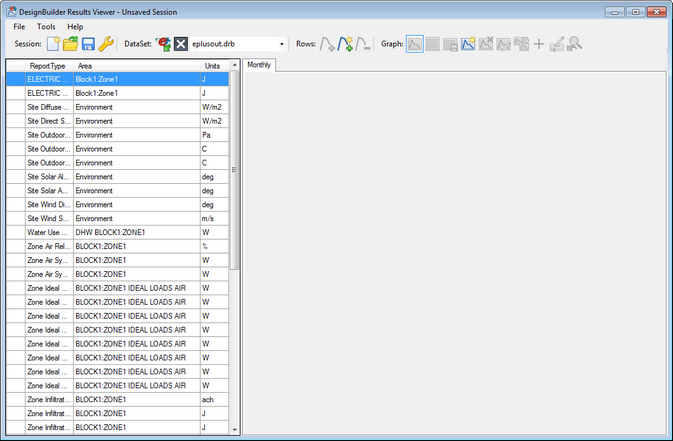
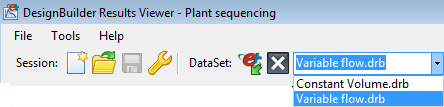
Multiple .eso and .htm files can be opened at a time. Use the combo box below the toolbar to select the current results set for plotting. With an .eso file open the first view will be something like that shown below.
DISPLAY RESULTS To show results for a particular interval use the Frequency drop list to select the interval. Sorting the Reports can be a useful way to help find particular data and can be achieved by clicking on the column headers. For example to see data sorted by "Area" click on the Area header. This will collect together all data for each zone, HVAC component, Environment etc. in the list. To plot a report on a graph use one of these methods:
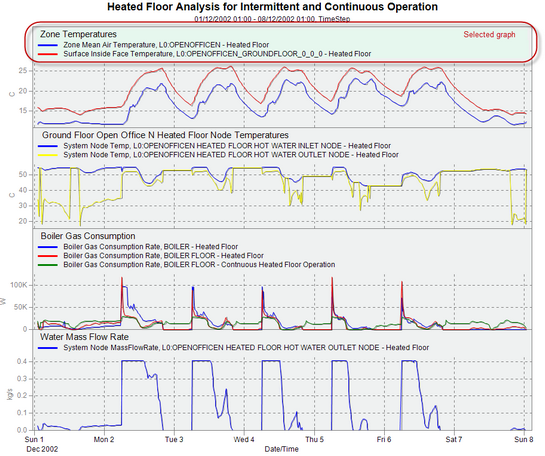
Selecting a graph If you have more than 1 graph set up you can select the current graph simply by clicking on it. You will see the graph heating highlight in a different blue when selected as shown below.
MENU COMMANDS You can access a range of options from the top bar menu, toolbar and right-click context menus. These are as follows: Display grid Display the data as a grid instead of a graph. Display graph Display the data as a graph instead of a grid. Save grid to CSV Allows you to save the data as a comma separated values file for loading into a spreadsheet for further analysis. Copy graphs to another frequency If you have generated similar data for multiple frequencies then use this tool to use settings for the current frequency and display the same reports using a different frequency. Change main title Change the text to be used for the main title for all graphs Rename graph title Allows you to change the title for the currently selected graph. To change the name of the current graph right-click on the graph and from the DesignBuilder Options, select the Rename graph title option. Enter the title for the graph in the dialog and press OK. Remove selected graph Deletes the current graph. Any data displayed in the graph is unaffected. Cross hair on/off Checking this option displayed a cross hair which allows you to create a vertical and horizontal line when you click on a data point. It can be useful to check simultaneous values for a range of reports. Template Load/Save When you create graphs with Results Viewer, they are styled (e.g. Title Font, Background colour, etc) using a default styling template. You can change the styling defaults to your own preferences by using the right-hand context menu on the graph pane. The following options are currently available:
If you make some changes and want to revert back to the default styling at any time, select the Tools > Restore Graph Styling menu option. Any styling changes made to the currently open session will be made permanent once the session has been saved. If you wish to reuse your styling changes, you can save these to a styling template file and apply them to other sessions. Use the Tools> Template > Save option to save your styling template as a standalone file, ie outside of the session (note: the '.drt' file extension is used for styling template files). The Tools > Template > Load option can then be used to apply this style to another session. LOADING MULTIPLE DATA SETS You can load as many data sets as required to a single Results Viewer session by using the Open eso/Dataset menu or toolbar option. A list is maintained of all data sets currently opened in the drop list at the top of the window.
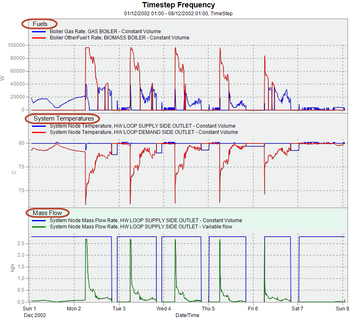
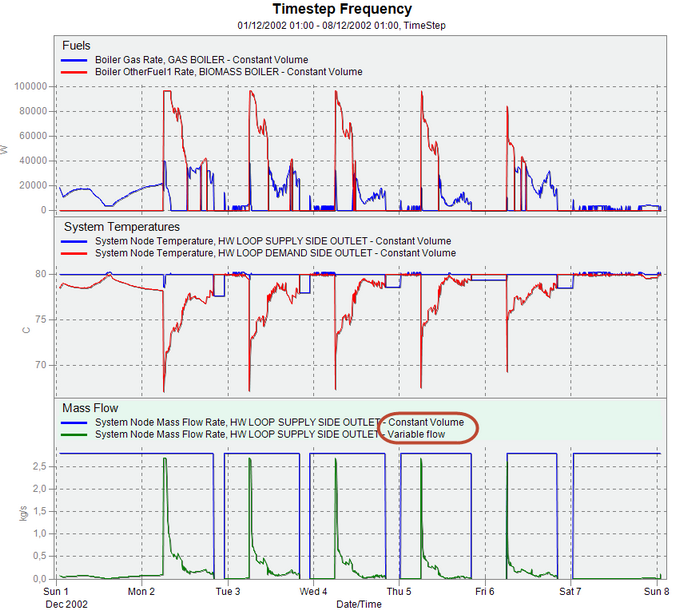
When you have more than one data set open it usually helps to Include the dataset name in the legend. This can be done from the Options dialog. OPTIONS DIALOG The Options dialog is accessed either from the toolbar Autosave session Select this option if you would like the session to be saved automatically when closing the Results Viewer. Display a title for each graph Selecting this option causes the title of each graph to be displayed for each graph as shown in highlighted areas in the graph below.
To change the name of the current graph right-click on the graph and from the DesignBuilder Options, select the Rename graph title option. Enter the title for the graph in the dialog and press OK. Include dataset name in legend If you have more than one data set loaded then you should usually select this option to ensure that the data set name is included in the legend. This can help when comparing results for different simulations.
The output above shows how the dataset name is added to each legend. Include folder name in dataset name If you include the dataset name in the legend then do you want the folder name included too? If so check this option. This option is only usually used when the result sets are stored in files with the same name but in different folders. ZOOMING In some cases you may find that too much data is displayed on the X-axis at one time and you need to focus on a section (time period) of the results graph. You can use the mouse to do this simply by dragging a time region of interest. This allows you to zoom in on data for particular days. To return back to the original "un-zoomed" state, use the Undo zoom toolbar option. SESSIONS It can take some time to load.eso files and to select results so DesignBuilder provides methods to save pre-processed results files and session files to speed loading and setting up reports the next time. .drb results files When the Results Viewer loads an .eso file it automatically generates a .drb file with exactly the same data but in a form that can be loaded much more quickly. If you need to view the results again in future you can open the drb file instead of the .eso file. The .drb file will have the same filename as the original .eso file (apart from the extension). It does not contain any display settings - just the data. .drs results files You can also save a session file which stores all of your display settings for a graphing session as well as the corresponding .drb file(s). Opening the session file will take you back to where you were before saving the session file. Session files provide a very useful way to package up all data and settings for a Results Viewer session in a small file size. They can be sent to colleagues for viewing. You can configure DesignBuilder to save.eso files in various ways as described for the EnergyPlus tab of the Program options. If you plan to use the Results Viewer in favour of the inbuilt DesignBuilder results display then you might use one of the settings configurations below:
P3dv5 Addons | RELIABLE — 2024 |Unlike previous versions (v3, v4), P3Dv5 has specific requirements:
The grandfather of P3D utilities. FSUIPC6 allows hardware controllers to map perfectly. It also handles wind smoothing, joystick calibration curves, and key mapping. While free alternatives exist, the registered version is non-negotiable for serious cockpit builders. P3Dv5’s claim to fame is "study-level" aircraft. These are simulators within the simulator. Pros: In 2026, Prepar3D v5 (P3Dv5) remains a cornerstone for high-fidelity procedural simulation, particularly for "study-level" airliners that have not yet fully migrated to newer platforms like MSFS 2024. While visually outpaced by modern simulators, P3Dv5’s ecosystem is defined by a mature library of "add-on" software that prioritizes systems depth and stable flight dynamics over graphical flair. Core Add-on Ecosystem The P3Dv5 experience is built on a foundation of essential utilities and high-detail aircraft that transform the base simulator into a professional-grade training tool. Study-Level Aircraft: Developers like PMDG (737NGXu, 747-400/8, 777) and FlightSimLabs (A320-X series) provide the most complex systems modeling available, featuring custom fly-by-wire logic and detailed electronic flight bags (EFBs). Essential Utilities: Active Sky: A critical weather engine that injects real-time atmospheric data. GSX (Ground Services X): Adds realistic ground handling, catering, and pushback procedures. ChasePlane: The industry standard for camera management, allowing for customizable cockpit and external views. Environment & Scenery: Orbx remains the primary provider for global texture replacements and high-detail regional airports, though many users now opt for selective "TrueEarth" regions to improve visual fidelity. Compatibility & Transition As of 2026, compatibility is a primary concern for the remaining P3D community. Compatibility Of Prepar3D V4/v5 Add-ons With Prepar3D V6 Prepar3D v5 (P3Dv5) remains a powerhouse for flight simulation, largely due to its 64-bit architecture and Enhanced Atmospherics (EA) engine. To get the most out of it, you need a mix of high-fidelity aircraft, environmental overhauls, and utility tools. Essential Aircraft Addons p3dv5 addons PMDG 737NGXu & 747-8: These are the gold standards for airliner realism. PMDG transitioned these specifically for P3Dv5 to take advantage of its improved memory management. FSLabs A320-X Series: Widely considered the most complex Airbus simulation available, featuring deep systems integration and realistic "Sharklets" variants. Leonardo SH MaddogX: For those who love "manual" flying, this MD-82 simulation is incredibly stable and highly detailed. Aerosoft Airbus Pro: A great mid-range option for those who want a solid A320/A321 experience without the steep learning curve of FSLabs. Environmental & Visual Overhauls Orbx Global Base & Vector: These are foundational addons that replace default textures and improve coastlines/roads worldwide. Active Sky P3D (ASP3D): Essential for realistic weather. It works alongside P3Dv5’s volumetric clouds to provide accurate turbulence and wind shears. REX 5 Sky Force & Environment Force: These tools allow you to tweak sky colors, sun effects, and cloud structures in real-time to match the P3D atmospheric engine. Scenery & Utility GSX Level 2 (Ground Services X): Adds animated ground crews, jetways, and refueling services to every airport, significantly boosting immersion during turnaround. Navigraph: While not an "addon" in the traditional sense, keeping your FMS data updated via Navigraph is crucial for flying accurate real-world procedures in P3Dv5. ChasePlane: A camera utility that replaces the clunky default views with smooth, cinematic movement and easy-to-configure presets. Installation Tip Most modern P3Dv5 addons utilize the XML installation method, which keeps files outside the main simulator folder. This prevents "bloat" and makes it much easier to reinstall the simulator without losing your addons. How to Install the P3Dv5 Enhancement Pack | 2023 Prepar3D v5 (P3Dv5) remains a cornerstone for serious flight simulation, particularly for users who value stable, high-fidelity aircraft systems and professional-grade utilities over the evolving visual landscapes of newer platforms like Microsoft Flight Simulator (MSFS). As of 2026, the addon ecosystem for P3Dv5 has transitioned into a "legacy-stable" phase, where major development has largely ceased, yet the available library is vast, refined, and highly functional. The Core Addon Categories Study-Level Aircraft: The primary draw of P3Dv5 is its library of complex aircraft. Developers like PMDG (737NGXu, 747-400/8) and FSLabs (A32x family) provide systems-heavy simulations that are often considered the benchmark for realism. Other notable entries include the QualityWings 787 and the iFly 737MAX, which utilize the platform’s DirectX 12 architecture to deliver improved performance over earlier versions. Unlike previous versions (v3, v4), P3Dv5 has specific Scenery and Environment: To modernize the visual experience, users rely on Orbx Global for enhanced ground textures and FreeMeshX for high-resolution terrain mesh. Weather injection is almost exclusively handled by Active Sky P3D, which is considered an essential utility for realistic atmospheric behavior. Immersion Utilities: Tools such as GSX (Ground Services X) for realistic airport ground operations and ChasePlane for advanced camera controls are ubiquitous in P3Dv5 setups. Performance and Compatibility P3Dv5 introduced a rewritten rendering engine using DirectX 12, which significantly improved VRAM management and overall frame rates compared to the 32-bit era of P3D v3 or the early 64-bit P3D v4. This shift makes it compatible with almost 95% of addons originally designed for P3D v4, allowing users to bring forward a massive library of previously purchased content. The Landscape in 2026 P3Dv5.1 | My essential add ons | 2021 A "useful paper" for Prepar3D v5 (P3Dv5) would typically serve as a configuration guide or a "Best-of" index for optimizing what is widely considered the most stable 64-bit platform for high-fidelity airliner simulation. Below is a structured white paper outline designed to help you organize your P3Dv5 addon ecosystem. P3Dv5 Ecosystem Optimization Paper 1. The Core Utility Layer (The "Must-Haves") These tools are the foundation of any stable P3D installation. Lorby-SI Addon Organizer Essential for managing scenery layers and addon XML files without cluttering the simulator's root directory. Active Sky P3D (ASP3D) The industry standard for weather injection. It offers superior turbulence modeling and accurate winds-aloft data compared to stock weather. ChasePlane A transformative camera utility that replaces the clunky default view system with smooth, customizable presets and "head shake" effects. GSX Level 2 Adds realistic ground services, including animated passengers and precise pushback logic. 2. Visual & Environment Enhancements To modernize the sim’s visuals, focus on texture and shader injection. ORBX Global Base Pack Replaces default ground textures globally to provide a more realistic look from any altitude. Envtex & Envshade These work together to enhance sky textures, water effects, and lighting shaders, giving P3Dv5 a more "modern" atmospheric feel. AIG AI Manager (Free) Tip: Always check for a “v5” or “v5 The best way to populate your airports with real-world airlines and liveries without a significant performance hit. Flight Sim Labs Forums 3. Study-Level Aircraft (The Highlights) P3D remains the home for several aircraft that have not yet reached full parity in newer simulators. Long-Haul Kings: series are the gold standard for long-range IFR operations. Short-Haul Precision: FSLabs A320-X family is widely considered the most advanced Airbus simulation available for any home consumer platform. Regional Mastery: Just Flight’s Fokker 70/100 Professional provides an incredibly detailed regional jet experience with full EFB integration. 4. Installation Strategy: The "Clean Root" Method One of the most important takeaways for P3Dv5 is avoiding the root directory External Folders: Whenever possible, use installers that allow you to install outside the main Prepar3D v5 folder. This makes updates and re-installs much faster. VRAM Management: P3Dv5 uses DirectX 12, which can be heavy on VRAM. If you experience "Device Hung" errors, reduce your Texture Resolution in settings or use the Lorby-SI Addon Organizer to disable scenery you aren't currently using. performance tuning for specific hardware, like NVIDIA GPUs? If you’re new to P3Dv5 and want the best bang for buck: That combo alone transforms default P3Dv5 into a near-professional flight training tool.
Would you like this tailored for a specific audience (e.g., airliner pilots, GA fans, or VR users)? P3Dv5 is the king of "Study Sim" aircraft. While MSFS is catching up, the depth of systems simulation available in P3D is currently unmatched, particularly for those interested in older airliners or turboprops. You don't need to spend $1,000. Here are essential freebies:
|
 or from the Tools top menu option.