
Sans For508 Index -
In the demanding world of digital forensics and incident response, few certifications carry as much weight as the GIAC Certified Forensic Analyst (GCFA). This credential, earned through the rigorous SANS FOR508 course, represents a professional’s ability to hunt advanced threats, analyze memory and disk artifacts, and respond to sophisticated breaches. Yet, even the most experienced practitioners acknowledge a crucial key to success on the exam: the FOR508 Index. Far from a simple cheat sheet, the FOR508 Index is a meticulously crafted, personalized roadmap that transforms a mountain of technical information into an accessible toolkit.
At its core, the FOR508 Index is a structured catalog of the course’s six massive books, which span topics from Windows and Linux forensics to memory analysis, timeline reconstruction, and threat hunting. Students build their index manually, typically using a spreadsheet, listing key concepts, commands, artifact locations, and tool outputs alongside the corresponding book and page number. For example, an entry for "MFT $STANDARD_INFORMATION vs. $FILE_NAME timestamps" would direct the user to the exact page where this critical distinction is explained. This process of creation is, in itself, a powerful learning exercise, forcing students to review and condense hundreds of pages of dense material.
The index’s primary function during the open-book GCFA exam is time management. The exam presents complex, scenario-based questions that require not just recall but application. A well-designed index allows a tester to locate a relevant artifact—such as the Windows Event ID for service installation (4697) or the offset of the ShimCache in a memory dump—within seconds. Without an index, an examinee would waste precious minutes flipping through volumes, risking failure under time pressure. The index thus acts as a high-speed lookup table, turning the open-book format from a potential liability into a decisive advantage.
However, the true value of the FOR508 Index lies beyond the exam. Seasoned incident responders often refine their indexes over years, adding real-world notes, custom scripts, and references to external threat intelligence. The index evolves from a test-taking aid into a living field manual. When a new adversary technique emerges—for instance, a novel method for bypassing PowerShell logging—a practitioner can quickly cross-reference related concepts like "AMSI bypass" or "ScriptBlock logging" within their index to refresh their understanding. In this way, the index institutionalizes knowledge, bridging the gap between classroom theory and the chaotic reality of a live breach.
Critics sometimes argue that relying on an index suggests a lack of mastery. But this misunderstands the nature of modern DFIR work. The field is too vast, and the pace of change too rapid, for any single analyst to commit every artifact path, registry key, and timestamp nuance to memory. The index is not a crutch; it is an exoskeleton. It empowers the analyst to focus cognitive energy on higher-order thinking—correlating evidence, reconstructing attack timelines, and making judgment calls—rather than on rote memorization.
In conclusion, the SANS FOR508 Index is far more than an exam accessory. It is a distillation of focused study, a practical tool for time-sensitive problem-solving, and a lasting repository of professional knowledge. Building it requires discipline and deep engagement with the material; using it effectively demands critical thinking. For anyone serious about mastering advanced incident response and forensics, creating and maintaining a FOR508 Index is not an optional shortcut—it is an essential practice that pays dividends long after the exam is over.
This is a story about the "Monster Index"—the legendary, multi-volume beast that stands between a SANS student and their GIAC Certified Forensic Analyst (GCFA) certification.
The caffeine had stopped being a stimulant three hours ago; now, it was just a baseline requirement for consciousness.
Alex sat at a kitchen table buried under six thick, spiral-bound books labeled
FOR508: Advanced Incident Response, Threat Hunting, and Digital Forensics
. In the center of this paper fortress lay the "Master Index." It wasn't just a list of terms; it was a map of a digital battlefield. The Construction Sans For508 Index
For three weeks, Alex hadn't just read the material—they had lived it. Every mention of a "Shimcache," every "Amcache" entry, and every "Prefetch" artifact was meticulously logged. Alex remembered the first day of the SANS FOR508
course. The instructor had warned them: "The exam is open-book, but if you have to read the book to find the answer, you've already failed. You need the index." So, Alex built. The Triage Phase:
Listing every Volatility plugin and what it revealed about memory. The Deep Dive: Mapping out the nuances of NTFS $MFT analysis. The Color Coding:
Green for artifacts, Red for attacker techniques, and Blue for the specific commands needed to find them.
Exam day arrived. The testing center was cold, smelling of stale air and silent panic. Alex laid out the index. It was a 40-page, tabbed masterpiece. Question 42 appeared:
An attacker used a specific WMI event consumer for persistence. Which registry key contains the consumer's command line?
Alex’s brain sparked. They knew it was in Book 4, but where? They didn't flip through the 800 pages of courseware. Instead, their finger flew to the section of the index. WMI Event Consumer Book 4, Page 112; Book 4, Page 115 (Command Line specifics)
In four seconds, the book was open to the exact diagram. The answer was there, hidden in a screenshot of a hex editor. The Aftermath
When the "Pass" screen finally flickered to life, Alex didn't just feel relief for the certification. They felt a strange kinship with the stack of paper beside them.
The FOR508 index wasn't just a study tool. It was the physical manifestation of a hunter's mind—organized, indexed, and ready to find the needle in a haystack of a hundred gigabytes of evidence. In the demanding world of digital forensics and
Alex walked out of the center, the heavy books under one arm and the index in the other. The certification would go on the wall, but the index? That was going in the "In Case of Emergency" drawer at work. Do you need help organizing specific topics
(like Memory Forensics or Timeline Analysis) for your own FOR508 index?
The Essential Companion: An Analysis of the SANS FOR508 Index
In the demanding world of digital forensics and incident response (DFIR), the SANS FOR508: Advanced Incident Response, Threat Hunting, and Digital Forensics course is widely considered a rite of passage for enterprise-level responders. While the course provides the technical knowledge to combat advanced persistent threats (APTs), the most critical tool for a student’s success—specifically during the open-book GIAC Certified Forensic Analyst (GCFA) exam—is not a piece of software, but a personally constructed Index. The Purpose: Beyond Simple Reference
At its core, a SANS index is a comprehensive, alphabetized roadmap to the thousands of pages of course material. However, its utility is twofold:
Time Management: The GCFA exam is a high-speed assessment where searching through six massive books for a specific detail is impossible without a guide. The index transforms the material into a "searchable, high-speed database".
Knowledge Reinforcement: The process of building the index is a critical study method. It forces the candidate to review the material page-by-page, identifying key concepts, tools, and artifacts. Experts often note that "the process of building a good index helps reinforce information" more than the final document itself. Structural Pillars of a Strong Index
A successful FOR508 index typically organizes information into a multi-column spreadsheet (often Excel) that is later printed and bound. Key columns usually include:
Keyword/Concept: Specific terms ranging from "MFT" (Master File Table) to "Shimcache".
Book and Page Number: Direct pointers to where the detailed explanation resides. Add a column: Exam Tip – write down
Short Description: A one-sentence summary to provide immediate context without needing to open the book.
Tools vs. Theory: Many students create specialized sections for command-line tools (e.g., volatility, sleuthkit) versus theoretical concepts like the "Incident Response Steps". Evolutionary Content: Adapting to Modern Threats
The index must evolve with the course, which is updated frequently to reflect modern attacker tradecraft. Recent iterations of the FOR508 course have added significant content on:
Credential Theft & Lateral Movement: New detection techniques for "LOLdrivers" and credential abuse. Memory Forensics: Advanced triage and memory dump analysis.
Timeline Analysis: The use of "Super-timelines" to reconstruct every action an attacker took on a system. Conclusion
The SANS FOR508 Index is far more than a "cheat sheet"; it is a professional artifact that bridges the gap between raw information and actionable intelligence. For the aspiring forensic analyst, the index represents the transition from a student learning about threats to a hunter capable of finding them in an enterprise environment. As veteran responders often say, you don't just "have" an index—you "build" it, and in doing so, you build the expertise required for the field.
The "Sans For508 Index" refers to the repository of digital forensics artifacts and challenges associated with the SANS FOR508: Advanced Digital Forensics, Incident Response, and Threat Hunting course.
Unlike a standard file directory, the "Index" in this context usually refers to the classified repository of evidence files, hypothetical scenario backstories, and forensic images used for the class exercises.
Here are the key features of the SANS FOR508 Index/Repository:
This is what you search for. Do not use the book’s heading. Use the question you expect to see.
After you finish the course, go through each book again. This time, look for:
Add a column: Exam Tip – write down any hint the instructor gave (e.g., "This will be on the test").
eFatigue gives you everything you need to perform state-of-the-art fatigue analysis over the web. Click here to learn more about eFatigue.
Sans For508 Index -
Welds may be analyzed with any fatigue method, stress-life, strain-life or crack growth. Use of these methods is difficult because of the inherent uncertainties in a welded joint. For example, what is the local stress concentration factor for a weld where the local weld toe radius is not known? Similarly, what are the material properties of the heat affected zone where the crack will eventually nucleate. One way to overcome these limitations is to test welded joints rather than traditional material specimens and use this information for the safe design of a welded structure.
One of the most comprehensive sources for designing welded structures is the Brittish Standard Fatigue Design and Assessment of Steel Structures BS7608 : 1993. It provides standard SN curves for welds.
Weld Classifications
For purposes of evaluating fatigue, weld joints are divided into several classes. The classification of a weld joint depends on:
- the macroscopic geometry of the pieces welded,
- the direction of the cyclic stresses, and
- the location of the crack that leads to failure.
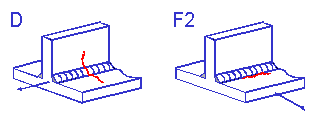
Two fillet welds are shown below. One is loaded parallel to the weld toe ( Class D ) and the other loaded perpendicular to the weld toe ( Class F2 ).
It is then assumed that any complex weld geometry can be described by one of the standard classifications.
Material Properties
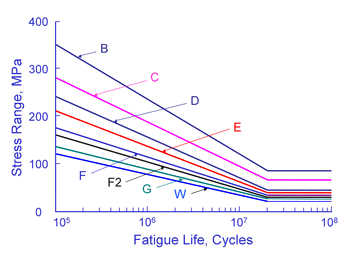
The curves shown above are valid for structural steel welds. Fatigue lives are not dependant on either the material or the applied mean stress. Welds are known to contain small cracks from the welding process. As a result, the majority of the fatigue life is spent in growing these small cracks. Fatigue lives are not dependant on material because all structural steels have about the same crack growth rate. The crack growth rate in aluminum is about ten times faster than steel and aluminum welds have much lower fatigue resistance. Welding produces residual stresses at or near the yield strength of the material. The as welded condition results in the worst possible residual or mean stress and an external mean stress will not increase the weld toe stresses because of plastic deformation. Fatigue lives are computed from a simple power function.

The constant C is the intercept at 1 cycle and is tabulated in the standard. This constant is much larger than the ultimate strength of the material.
The standard is only valid for fatigue lives in excess of 105 cycles and limits the stress to 80% of the yield strength. Experience has shown that the SN curves provide reasonable estimates for higher stress levels and shorter lives. In eFatigue, the maximum stress range permitted is limited by the ultimate strength of the material for all weld classes.
Design Criteria
Test data for welded members has considerable scatter as shown below for butt and fillet welds.
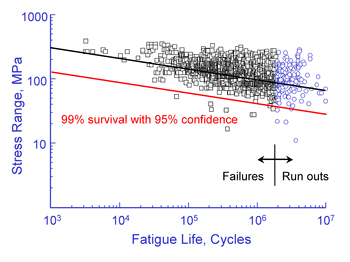
Some of this scatter is reduced with the classification system that accounts for differences between the various joint details. The standard give the standard deviation of the various weld classification SN curves.
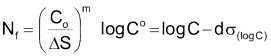
The design criteria d is used to determine the probability of failure and is the number of standard deviations away from the mean. For example d = 2 corresponds to a 2.3% probability of failure and d = 3 corresponds to a probability of failure of 0.14%.
Copyright © 2026 Crossroad World